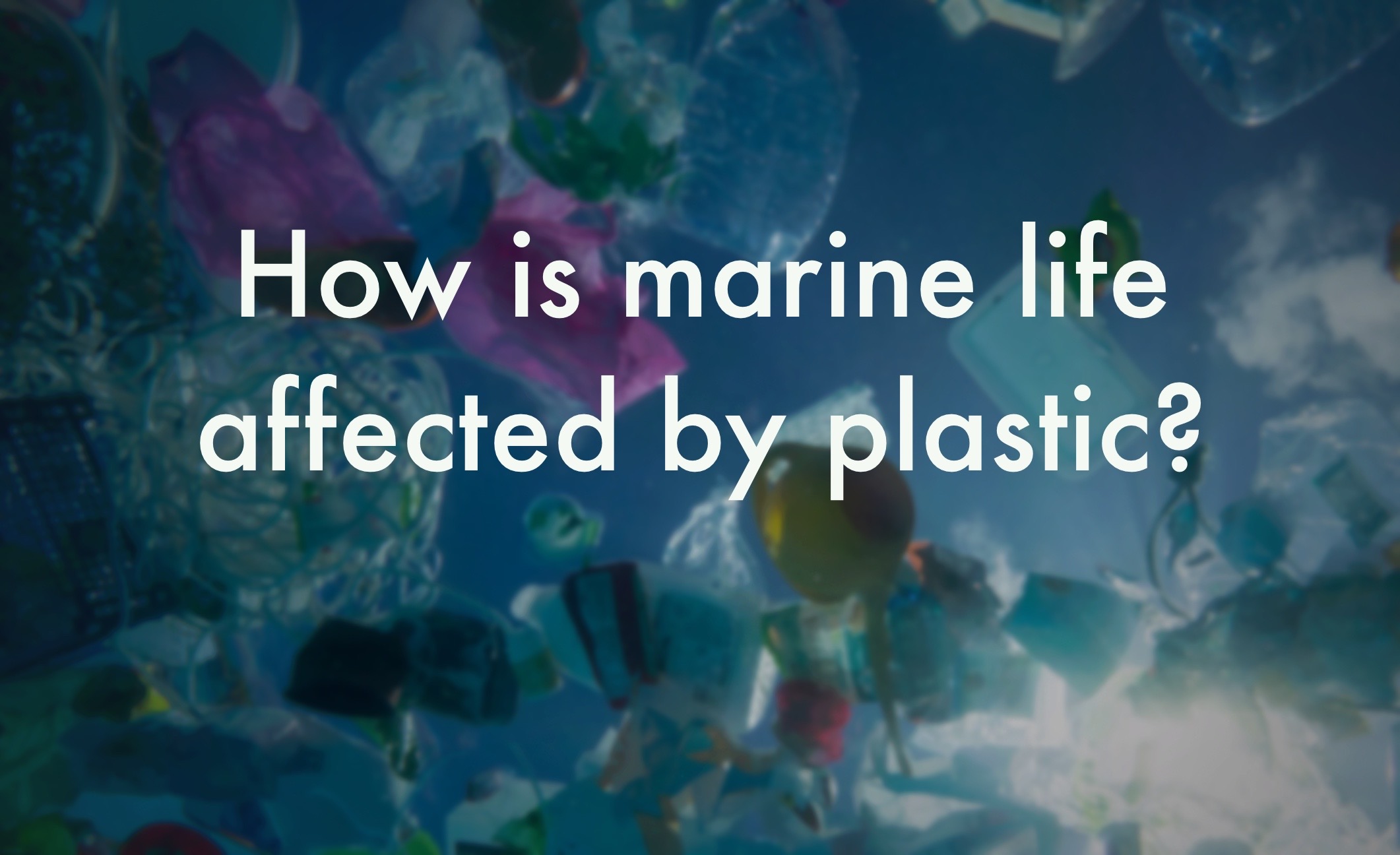
How is Marine Life Affected by Plastic Pollution?
Posted by Maria Geoly on March 31, 2026
A brief overview of how marine life is affected by plastic pollution.
Plastic pollution refers to the accumulation of long-lasting plastic waste in oceans and waterways, which threatens marine animals, damages ecosystems, and disrupts natural processes. Plastic breaks down into tiny pieces that linger for centuries. As a result, even the most remote ocean regions exhibit signs of contamination, underscoring the severity and scope of the problem.
How Do Plastics Enter the Ocean?
Plastic pollution doesn’t begin in the ocean; it begins with everyday choices and actions. Choosing single-use plastics at the grocery store instead of bringing reusable bags, buying bottled water rather than carrying a refillable bottle, or improperly disposing of plastic waste all contribute to the problem. A dropped water bottle on a highway, a shopping bag blown out of a bin, or a straw left behind on a beach may seem minor, yet these items can travel far. For example, strong winds can easily lift lightweight plastics out of trash bins and push them into drains, fields, or waterways. Once plastic enters rivers and streams, it can eventually make its way to the ocean. There, sunlight and wave action cause plastic to break into smaller pieces over time. However, this is only physical fragmentation; plastic does not truly biodegrade into natural, organic nutrients.
Rainwater washes plastic into storm drains. From there, they move through rivers like the Mississippi, Columbia, and Hudson, eventually finding their way to the sea. Once in the ocean, they drift with the tides, break into pieces, and become almost impossible to retrieve. Research shows that more than 80% of ocean plastic originates from land-based sources, traveling through rivers before reaching the sea. Every year, 19–23 million tonnes of plastic waste leak into aquatic ecosystems, polluting lakes, rivers, and seas.
Plastic production has sharply increased over the last 70 years. Current estimates indicate that we produce over 450 million tons of plastic annually, an amount roughly equivalent to the combined weight of hundreds of thousands of fully loaded commercial airplanes each year. Of that, at least 11–14 million tons end up in the ocean every year, which is comparable to dumping a garbage truck full of plastic into the sea every single minute. That’s more than 2000 trucks every single day. Perhaps most alarming is the future trajectory: a landmark report by The Pew Charitable Trusts predicts that, without drastic systemic change, the f plastic into the ocean could triple by 2040, to 29 million metric tons per year. That’s the same as dumping 110 pounds (50 kilograms) of plastic on every meter of coastline around the world each year.
The Price Marine Life Pays for Our Plastic Waste
Plastic waste in the ocean is causing direct harm to marine animals. Many species ingest plastic or become entangled in debris, which can lead to injury, starvation, or death. As plastic pollution increases, more wildlife is being exposed to these risks.
-
The Sea Turtle That Mistook Plastic for Food
Sea turtles mistake floating plastic bags for jellyfish due to their similar appearance. When ingested, plastic creates false satiety, tricking the turtle’s brain into thinking it’s full. This leads to starvation even when the stomach is full of plastic. For example, a juvenile sea turtle washed up on shore in Florida. When wildlife rescuers examined it, they discovered its stomach was filled with pieces of plastic bags and balloon fragments. The turtle had starved because its stomach was blocked.
In a study of 464 green turtles that stranded in the Gulf of Mexico between 1987 and 2019, 226 (48.7%) were found to have ingested plastic. The rate of plastic ingestion among stranded turtles rose over time, from ~32.5% in 1987–1999 to ~65.5% by 2019, showing the problem has worsened in recent decades. Because green turtles are already listed as threatened or endangered in many regions, increasing plastic ingestion, particularly among juveniles, raises concern for long-term population stability, as fewer individuals may survive to reach reproductive age.
-
Recent Cases Showing the Deadly Impact of Plastic on Whales
Plastic pollution has become one of the most serious and widespread threats to whales worldwide. Scientific studies and necropsies consistently show that plastic ingestion is no longer a rare or isolated occurrence, but a common and often fatal problem affecting multiple whale species across all major oceans.
In 2023, a sperm whale washed up off the coast of Kauai, Hawaii, with its stomach containing discarded fishing gear, plastic bags, and nets. Scientists concluded that this plastic debris likely contributed to its death by causing internal damage and digestive blockage. More recently, in 2024, a stranded dwarf sperm whale calf was found on a Florida beach with plastic debris discovered in its digestive tract, highlighting how even young whales are not spared from plastic exposure early in life.
Large cetaceans are particularly vulnerable because many whales feed by gulping massive volumes of water to capture prey. This feeding strategy makes it easy for floating plastic to be swallowed unintentionally. Once inside the body, plastic can cause internal tears, infections, ulcers, false feelings of fullness, and complete digestive blockages, often leading to slow starvation or fatal complications.
These documented cases represent only a small fraction of the true scale of the problem. Many whales die at sea and are never recovered, meaning plastic-related deaths are likely significantly underreported. While long-term population-level impacts are still being studied, plastic ingestion and entanglement are recognized as widespread threats to whale health, with potential long-term implications for vulnerable species.
-
Seabirds That Mistake Plastic for Food
On islands like those in the Northwestern Hawaiian region, seabirds collect floating plastic pieces, thinking they’re fish eggs. They bring this back to their chicks, who slowly fill up on plastic until they starve.
A global review found that among 135 seabird species studied (1962–2012), 80 species (≈ 59%) had ingested plastic. Across those studies, on average, about 29% of sampled individual seabird adults or juveniles had plastic in their digestive tracts.
A recent study (2025) showed that seabird chicks that ingested plastic had proteomic markers, which are measurable proteins in the body that indicate a biological condition, process, or disease. This leads to stress organs in seabirds and leads to changes in proteins linked to the liver, kidney, brain, and other organs. Some even showed signs consistent with severe organ damage, a strong indication of plastic harming their internal health, not just causing external harm.
-
The Silent Killers: Ghost Fishing Nets
According to the report, 66% of marine mammals, 50% of seabirds, and all seven sea turtle species have been documented as impacted by ghost gear or plastic debris. Lost or abandoned fishing nets, known as ghost nets, continue to trap marine life for years. In U.S. waters and globally, ghost gear has been documented as a cause of entanglement and mortality in seals, sea lions, sea turtles, and fish, contributing to impacts across the majority of marine mammal species worldwide.
What is a microplastic?
Microplastics are tiny plastic particles, typically smaller than 5 millimeters, that originate from the breakdown of larger plastic items or are intentionally manufactured at small sizes, such as microbeads in cosmetics or fibers from synthetic clothing. They persist in the environment, polluting oceans and soil, being ingested by wildlife, and entering the human food chain.
A Closer Look at the Types of Plastic Found in Waters
| Types Of Plastic | Where it comes from | Impact on Marine Life |
|---|---|---|
| Plastic Bags | Grocery stores, packaging | Mistaken for food; causes internal blockage |
| Bottles and Caps | Household waste | Internal injury when swallowed |
| Straws and Cutlery | Restaurants, takeout | Harmful when ingested; poses entanglement risk |
| Fishing Nets and Lines | Commercial, recreational | Entangles and kills turtles, dolphins, seals, and sharks |
| Microplastics (<5 mm plastic particles) | Broken plastic, cosmetic microbeads, clothing fibre | Being ingested; carrying toxic chemicals; causing injury, starvation, and reduced reproduction |
Why This Matters?
Let’s take the example of how plastic affects ocean water and marine life in the United States. The United States has three major ocean coastlines: the Atlantic, Pacific, and Gulf of Mexico. The United States relies heavily on healthy oceans. Millions of Americans living near the coast depend on the sea for jobs, food, tourism, and cultural identity. Plastic pollution affects several key sectors, as illustrated below:
1. Fisheries in Alaska, Maine, and the Gulf Coast are finding microplastics in fish and shellfish. After ingested, microplastics can harm marine life by causing internal injuries, exposing the organism to toxic chemicals, reducing growth, and contributing to reproductive problems. For humans, consuming seafood contaminated with microplastics may lead to the intake of microplastics and associated toxins, potentially affecting digestion, immunity, and long-term health.
2. Tourism-heavy states like Hawaii, California, and Florida face declining beach quality and increased cleanup costs. Declining beach quality and increased pollution harm marine life by damaging coastal habitats, causing entanglement or ingestion of debris, and disrupting breeding areas. For humans, polluted beaches reduce tourism income, increase public cleanup costs, and threaten local jobs and economic activity by directly affecting fisheries, coastal recreation, and tourism-dependent businesses.
3. Coastal wildlife rescue centers are reporting an increase in cases of animals injured or killed by plastic debris over the past decade. Studies of over 10,000 marine animals show many die from ingesting plastic, including about 35% of seabirds and 47% of sea turtles. Plastic debris harms marine life by causing entanglement, choking, internal injuries, and death, while also disrupting feeding and migration patterns. For humans, these impacts reduce biodiversity, damage fisheries and tourism, increase conservation and cleanup costs, and threaten food security and coastal livelihoods.
4. Public health concerns grow as microplastics appear in seafood, salt, and drinking water. Many coastal communities already report seeing more plastic washed onto their beaches every year. For states like California, Florida, Hawaii, and the Carolinas, this problem is becoming increasingly visible.
Studies show that microplastics can carry toxic chemicals and trace metals such as mercury and lead, which may enter the human body through contaminated food and water. Scientists warn that prolonged exposure may contribute to inflammation and other potential long-term health risks, although the full impact on human health is still being studied.
The Hidden Problem: Microplastics
Beyond visible plastic debris, the smallest particles pose an additional risk. These microscopic fragments can move easily through marine ecosystems and into the food web. Scientists are still studying the long-term effects, but these particles can carry attached chemicals and pollutants into marine organisms. Once ingested, toxins accumulate within tissues over time—a process known as bioaccumulation. As predators consume contaminated prey, those toxins become increasingly concentrated, a process called biomagnification. While these contaminants were originally present in seawater in diluted amounts, they can reach much higher concentrations inside the tissues of marine animals as they move up the food chain.
These tiny fragments, barely visible to the naked eye, are found around the world, from Southeast Asia to Africa and the Americas. Microplastics have been detected in Arctic sea ice, deep-sea sediments, and even in the Mariana Trench, demonstrating that no part of the ocean is untouched. Because they are so small, they are extremely difficult to remove and often carry harmful chemicals that attach to their surface. Scientists are still studying their long-term effects, but early research suggests ingestion may disrupt growth, digestion, and reproduction in marine animals and potentially humans. Studies have also documented microplastic pollution in seawater and marine organisms across the Tropical Eastern Pacific and the Galápagos.
Ways for reducing Microplastics Contamination
Plastic pollution may be a global problem, but solutions can start locally.
What Individuals Can Do
1. Cut down on single-use plastics
2. Use reusable bags, containers, and bottles
3. Dispose of waste responsibly
4. Organize or join local beach cleanups
What Communities Can Do
1. Improve waste collection and recycling
2. Offer incentives to reduce plastic use
3. Educate residents and schools about ocean pollution
What the Government Can Do
1. Push for stricter plastic regulations and enforcement
2. Support research and cleanup programs
3. Encourage and support sustainable alternatives
Long-term change requires shifting to a circular economy, designing products for reuse, not disposal. International agreements to limit plastic production, combined with extended producer responsibility (EPR), are essential to reducing ocean-bound plastic.
 Further Resources
To learn more about pollution reduction strategies and chemical contaminants affecting marine and human health, explore these additional resources:
– Understanding PFAS and Water Contamination
CONCLUSION
Every cleanup, every dataset, and every volunteer effort contribute to understanding and reducing plastic pollution. Plastic pollution affects coastlines around the world, threatening marine life, disrupting ecosystems, and impacting the well-being of coastal communities. To address this growing concern, the Oceans Research Institute launched a beach monitoring program in 2022, bringing interns and volunteers together to document pollution and conduct regular clean-ups along Mossel Bay. By recording the different types of waste collected, identifying hotspots, and tracking long-term patterns, the team is creating valuable data that supports meaningful conservation action. Their efforts highlight the importance of community involvement and remind us that every cleanup, every observation, and every piece of plastic removed contributes to a cleaner and healthier ocean.