Ocean Dead Zones: The Growing Crisis Beneath the Waves
Posted by Enrico Gennari on August 6, 2026
Beneath the ocean's shimmering surface, a hidden crisis is spreading. Ocean dead zones are oxygen-depleted areas that threaten marine life, biodiversity, fisheries, and coastal ecosystems worldwide. Discover what causes these expanding hypoxic zones, how they affect ocean species, and the solutions helping restore healthier marine ecosystems.
Beneath the ocean’s shimmering surface, a hidden crisis is spreading. Oxygen-starved waters where marine life suffocates—also known as dead zones—are transforming vibrant ecosystems into underwater graveyards. Spanning millions of square kilometers, these hypoxic zones are growing, threatening biodiversity, fisheries, and coastal communities. Let’s uncover what causes this threat, explore its impacts, and examine how we can work to reverse its spread.
What Causes Ocean Dead Zones?
Picture a barren underwater desert where fish, corals, and shellfish can no longer survive. Now imagine over 400 of these areas worldwide, covering a combined area larger than the United Kingdom. These oxygen-depleted areas are known as ocean dead zones and have become one of the most significant environmental challenges affecting coastal marine ecosystems.
What Causes Oxygen Depletion in the Ocean?
Ocean dead zones develop when dissolved oxygen levels in seawater drop too low to support most marine life, a condition known as hypoxia. While hypoxia can occur naturally under certain ocean conditions, the rapid increase in ocean dead zones is primarily driven by human activities. Excess nutrients, particularly nitrogen and phosphorus from agricultural fertilizers, sewage, industrial waste, and urban runoff, are carried into rivers, estuaries, and coastal waters, where they disrupt the natural balance of marine ecosystems.
How Do Ocean Dead Zones Form?
Excess nutrients fuel rapid algal blooms that can spread across large coastal and marine environments. As the algae die, bacteria decompose the organic matter, consuming large amounts of dissolved oxygen in the process. When oxygen is depleted faster than it can be naturally replenished, hypoxic conditions develop, forcing fish and other mobile marine species to migrate in search of oxygen-rich waters, while shellfish, corals, and other bottom-dwelling organisms often cannot escape. Over time, these oxygen-starved waters develop into ocean dead zones, reducing marine biodiversity, disrupting food webs, threatening fisheries, and affecting the long-term health of coastal ecosystems.
Dead Zones in Action: How Hypoxia Is Reshaping the Chesapeake Bay and Baltic Sea
Each summer, the Chesapeake Bay—the largest estuary in the U.S.—experiences widespread hypoxia. Nutrient-rich runoff from farms and cities fuels algal blooms that choke the bay’s waters, depleting oxygen and devastating ecosystems. These dead zones reduce available habitat and disrupt breeding cycles, causing harvest declines and economic losses for fishers, seafood processors, and local tourism. Blue crabs, oysters, and fish, which support Maryland’s multimillion-dollar seafood industry, are among the hardest hit. Unfortunately, hypoxia has worsened over the past few decades, now affecting over 40% of the estuary during peak summer months.
The Baltic Sea suffers from one of the world’s largest dead zones, spanning more than 70,000 square kilometers—nearly one-sixth of the global total. That’s more than the entire area of Ireland. Limited water exchange between the Baltic and the North Sea, due to its semi-enclosed geography, traps excess nutrients and slows natural flushing. This, combined with persistent nutrient runoff from agriculture and urban sources, has led to long-term oxygen depletion. As a result, commercial fish stocks have collapsed in several regions, and communities once reliant on fishing and maritime activities have faced sharp economic and ecological downturns. To address the crisis, regional governments launched the HELCOM Baltic Sea Action Plan, promoting sustainable farming, better wastewater treatment, and international monitoring. However, progress has been slow due to the scale and complexity of the issue.
The Baltic Sea is one of the world's most extensively studied marine ecosystems, providing decades of scientific evidence on the expansion of ocean dead zones. Long-term monitoring reveals how nutrient pollution, water stratification, and seasonal oxygen depletion have contributed to the persistence of hypoxic conditions. The following data visualizations illustrate the historical growth of hypoxic areas, seasonal oxygen fluctuations, and the influence of water stratification on oxygen availability in the Baltic Sea.
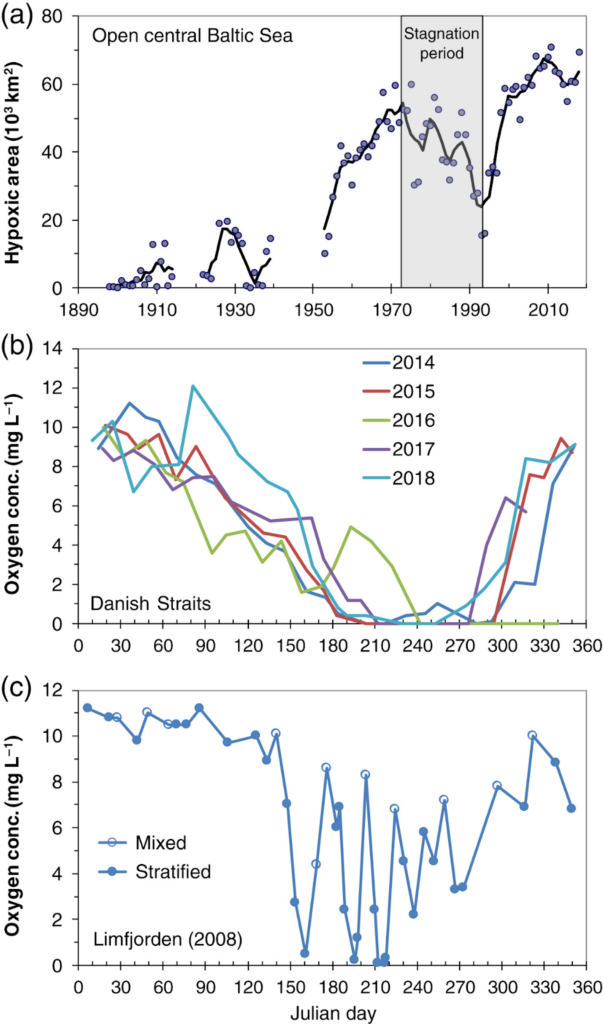
Figure: Long-term oxygen conditions and hypoxia trends in the Baltic Sea region. (a) shows the historical expansion of hypoxic areas in the open central Baltic Sea since the early 1900s, with a temporary stagnation in the late 20th century before increasing again. (b) illustrates seasonal oxygen concentrations in the Danish Straits across multiple years, highlighting recurring periods of low oxygen. (c) compares oxygen concentrations in mixed and stratified waters in Limfjorden during 2008, demonstrating how water stratification limits oxygen exchange and contributes to persistent hypoxia.
Source: Association for the Science of Limnology and Oceanography (ASLO)
How Climate Change and Human Activities Contribute to Ocean Dead Zones
Climate change is intensifying the spread and severity of ocean dead zones. Warmer waters naturally hold less dissolved oxygen, and today’s oceans are warming at an unprecedented rate. This alone can drive hypoxic conditions, but the impacts don’t stop there. Climate-driven changes in rainfall patterns, especially heavier downpours, flush larger amounts of nutrients like nitrogen and phosphorus into rivers and coastal zones. These nutrient surges fuel massive algal blooms that ultimately lead to dead zones.
One of the starkest examples is the Gulf of Mexico, where warming temperatures and agricultural runoff have created one of the largest recurring dead zones in the world. In 2023, the zone spanned approximately 8,185 square miles—an area roughly the size of New Jersey. As shown in the map below from the National Oceanographic and Atmospheric Administration (NOAA), bottom oxygen levels across a large swath of the northern Gulf fall below critical thresholds, with the most severe hypoxia (marked in red) dominating waters off the coasts of Louisiana and Texas. This visual underscores the geographic scale and intensity of the oxygen loss.
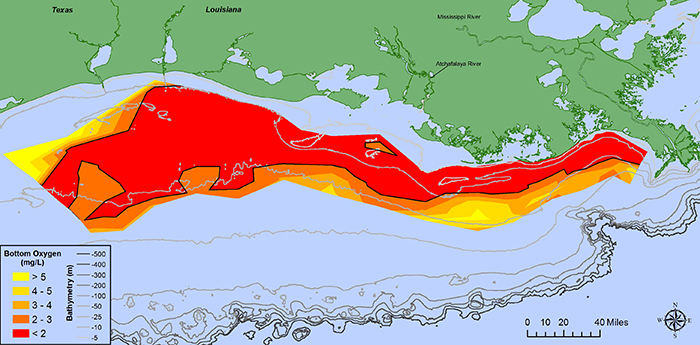
Map: Bottom oxygen concentrations in the northern Gulf of Mexico during July 2023. Red and orange areas represent severe hypoxia (less than 2 mg/L dissolved oxygen), illustrating the extent of the Gulf’s annual dead zone.
Source: National Oceanic and Atmospheric Administration (NOAA)
Human activities compound these effects. Deforestation increases erosion, sending nutrient-rich soil into waterways. Urbanization and coastal development destroy wetlands, which naturally filter out pollutants before they reach the sea. Overfishing also plays a role, removing key species like oysters and menhaden that help control algal growth by filtering water and consuming plankton. As these stressors combine, they lock ecosystems into a destructive cycle of oxygen loss, biodiversity collapse, and declining water quality.
Consequences for Marine Life and Biodiversity
Ocean dead zones can transform productive marine ecosystems into oxygen-starved environments where many species struggle to survive. Mobile species such as fish and crustaceans may migrate away from oxygen-poor waters, but less mobile organisms including shellfish, corals, and many bottom-dwelling species often cannot escape and may experience stress, reduced growth, reproductive failure, or mortality. This loss of biodiversity weakens ecosystem resilience because removing key species reduces the ability of marine ecosystems to adapt, recover, and maintain important ecological functions.
The effects of dead zones extend beyond individual species. When key organisms disappear, food webs become disrupted, affecting predators that depend on these species for survival. The loss of filter feeders such as oysters can also reduce the ecosystem’s ability to naturally improve water quality, creating conditions that allow oxygen depletion to persist.
Ocean dead zones also create significant economic impacts for coastal communities. Coastal regions face economic losses in fishing and tourism industries because dead zones reduce valuable marine populations and affect the quality of coastal environments. Species like crabs, oysters, and fish can experience population declines under prolonged hypoxic conditions, leading to fewer catches and reduced income for local fishers. Additionally, algal blooms and declining water quality can reduce the appeal of coastal areas, create potential health concerns for humans and pets, and negatively affect tourism-dependent communities.
Read: Chesapeake Bay Hypoxia Report – 2024 Year End Summary
Solutions to Reverse Ocean Dead Zones
Despite the scale of the problem, ocean dead zones can be reduced through targeted conservation efforts, improved water management, and changes in human activities. By addressing the major causes of oxygen depletion, scientists, governments, farmers, and communities can help restore healthier marine ecosystems. Here are some of the key solutions helping to prevent and reverse the spread of ocean dead zones:
Reduce Nutrient Runoff
Farmers can adopt practices like buffer zones (areas of vegetation along water bodies that filter out excess nutrients before they reach water) and cover cropping (growing specific plants to reduce soil erosion and nutrient loss). These strategies help prevent the over-fertilization of waterways, which can lead to dead zones. For example, in the Chesapeake Bay area, farmers have successfully used buffer zones to reduce nutrient runoff by up to 40%. Cities can invest in better wastewater treatment and stormwater systems to filter pollutants before they reach the sea.
Restore Natural Filters
Rebuilding wetlands, mangroves, and coastal vegetation can improve water quality by acting as natural filters and providing habitats for marine life. In South Africa, the restoration of mangroves has helped improve water quality in coastal areas, supporting marine biodiversity. Similarly, parts of the U.S. have seen success with wetland restoration efforts, such as in the Gulf of Mexico, where coastal marshlands have been restored to help mitigate the effects of hypoxia.
Use Smart Technology
Satellites and underwater sensors help scientists monitor algal blooms and oxygen levels in real time, allowing for early interventions such as adjusting wastewater discharges or activating response teams to mitigate harmful algal growth. These tools also help scientists predict future oxygen-deprived zones. For example, satellite data is already being used by teams in the U.S. to track algal blooms along the Gulf Coast, enabling authorities to issue health advisories, adjust wastewater discharge levels, and coordinate local responses before the blooms expand.
Strengthen Global Cooperation
Ocean pollution crosses borders. Programs like the UN’s Global Programme of Action and regional action plans like HELCOM (the Baltic Marine Environment Protection Commission) are essential for coordinating international efforts. HELCOM, for instance, includes countries like Finland, Germany, and Poland, all working together to reduce nutrient pollution in the Baltic Sea. This program implements actions such as stricter nutrient limits and measures to reduce agricultural runoff. The success of HELCOM’s initiatives is measured by the improvements in water quality in the Baltic Sea, although challenges remain in fully achieving their goals.
Frequently Asked Questions About Ocean Dead Zones
What causes an ocean dead zone?
Ocean dead zones are mainly caused by excess nutrients, such as nitrogen and phosphorus, entering the ocean through agricultural runoff, sewage, and pollution. These nutrients fuel algal blooms, and their decomposition removes oxygen from the water, creating hypoxic conditions.
Where are dead zones in the ocean?
Ocean dead zones are commonly found in coastal areas, estuaries, and enclosed seas affected by nutrient pollution. Major examples include the Gulf of Mexico, Baltic Sea, Chesapeake Bay, and regions near large rivers carrying agricultural runoff.
How do ocean dead zones form?
Ocean dead zones form when nutrient pollution triggers large algal blooms. As algae die and decompose, bacteria consume dissolved oxygen faster than it can be replaced, creating oxygen-depleted waters where many marine species cannot survive.
Is water in dead zones toxic?
Water in ocean dead zones is not always toxic, but it contains extremely low oxygen levels that can suffocate marine organisms. Some areas may also experience harmful algal blooms that produce toxins affecting marine life and human health.
What are the solutions to ocean dead zones?
The main solutions include reducing nutrient pollution, improving wastewater treatment, restoring wetlands, and using sustainable farming practices. Limiting nitrogen and phosphorus runoff helps prevent oxygen depletion and supports the recovery of healthier marine ecosystems.
How can we fix dead zones in the ocean?
Dead zones can be reduced by controlling pollution sources, restoring natural coastal filters like wetlands and mangroves, and improving water management. Long-term recovery requires cooperation between scientists, governments, industries, and local communities.
What is the largest dead zone in the world?
The Arabian Sea contains one of the largest naturally occurring oxygen-depleted zones in the world. Among human-caused coastal dead zones, the Gulf of Mexico dead zone is one of the largest and most widely studied examples.
Are ocean dead zones increasing worldwide?
Yes, many ocean dead zones are increasing due to nutrient pollution, climate change, and rising ocean temperatures. Warmer waters hold less dissolved oxygen, making marine ecosystems more vulnerable to hypoxia and biodiversity loss.
Protecting Our Oceans: The Path Forward
Expanding ocean dead zones are a clear and urgent signal that human activities are disrupting the health of marine ecosystems. While the issue is serious, targeted actions have shown real potential in reversing the damage, such as reducing agricultural runoff, restoring wetlands, and improving wastewater systems in coastal regions. Solutions exist; the challenge is scaling them.
Although Oceans Research Institute does not directly work on ocean dead zones, we support related marine conservation through scientific research and data sharing. Our team contributes to global understanding by monitoring ecosystem changes, publishing findings, and providing guidance that informs better marine management.
We offer accessible, research-based information to the public, students, and policy professionals seeking to engage in ocean conservation. By supporting ocean literacy and evidence-based policy, we help empower those working on the front lines of marine restoration. Progress depends on collaboration among scientists, decision-makers, and communities to protect biodiversity and secure the future of our oceans.